

The curious case of ruby gold
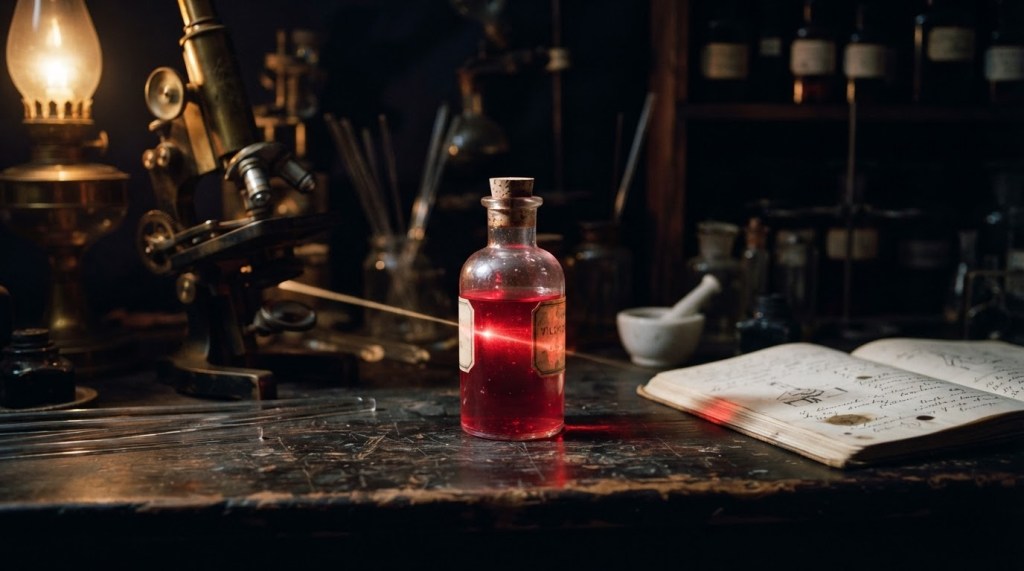
Gold is yellow. Few things in nature seem more certain. Rings, coins and medals all have that warm, metallic shine. Yet in a museum in London there is a small bottle of gold that is not yellow at all. It is a clear, deep ruby red. It contains no dye and no other metal. It is simply gold, and the only thing that has changed is how small it is.
A scientist fascinated by light
That bottle was made by Michael Faraday. By 1856 he was 65, had worked at the Royal Institution for more than forty years, and was probably the most famous experimental scientist in Britain. He had discovered electromagnetic induction, worked out the laws of electrolysis and, in 1845, shown that a magnet could affect light passing through glass.
Light was still a puzzle to him. Nobody knew what it really was or how it interacted with matter. Gold looked like a good place to start. It has a strong color, and it can be beaten into leaf so thin that light passes through it. Held up to a window, gold leaf glows green, not yellow.
An unexpected discovery
Faraday spent most of 1856 on gold. He made hundreds of thin films, some by beating gold leaf even thinner and others by depositing gold from solutions of gold chloride. More than 600 of his slides still survive.
While washing some of these films, he noticed that the rinse water had a faint ruby tint. Gold had come off the slides and was hanging in the water. He followed it up deliberately: he reduced gold chloride with phosphorus dissolved in carbon disulfide and got a ruby-colored liquid. When he shone a beam of light through it, the path of the beam lit up inside the liquid. Something in there was scattering light. He presented the work as the Bakerian Lecture to the Royal Society in February 1857.
When gold stopped looking like gold
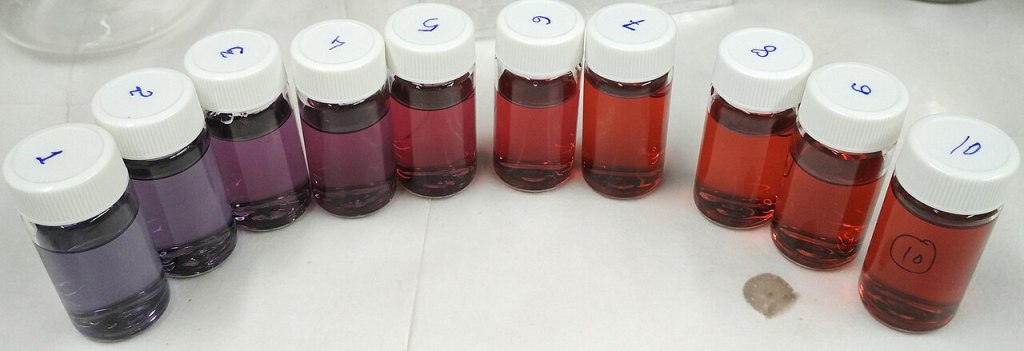
Faraday’s ruby liquid was what we now call colloidal gold: tiny particles of solid gold dispersed in water. He found that the color was not fixed. Adding a little common salt turned the ruby liquid violet and then blue. Different preparations gave ruby, purple or blue.
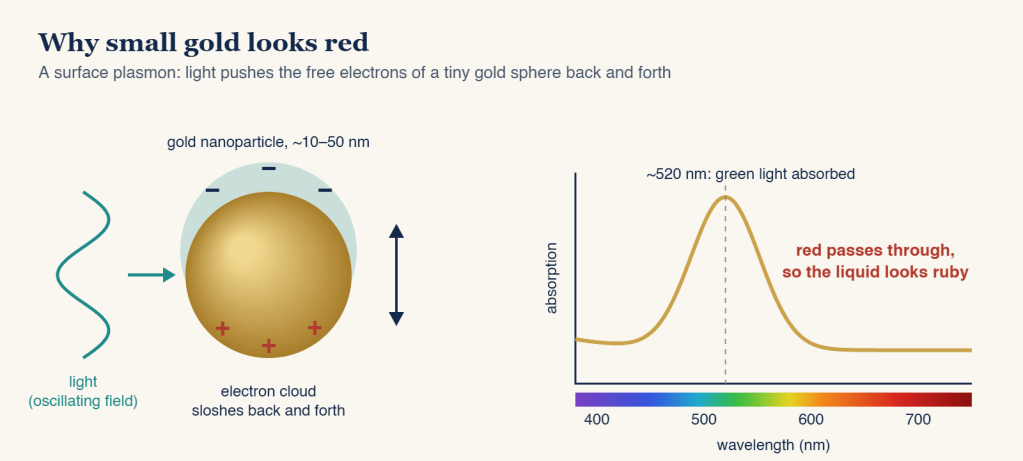
Today we know why. Small, separate gold particles absorb green light strongly, so the light that gets through looks red. When the particles clump together, they absorb longer wavelengths instead, and the liquid turns purple or blue. The color is affected by particle size.
What Faraday could see, but could not explain
Faraday argued that the gold was still metallic gold, just in a finely divided state, with particles “very minute in their dimensions”. He was right. But his microscopes could not show them, because the particles were much smaller than the wavelength of light.
He also had no theory to explain the color. The electron would not be discovered for another forty years. The modern explanation is the surface plasmon: light makes the free electrons in a small metal particle slosh back and forth together. For gold particles of a few tens of nanometers, that oscillation lines up with green light.
Gold before Faraday
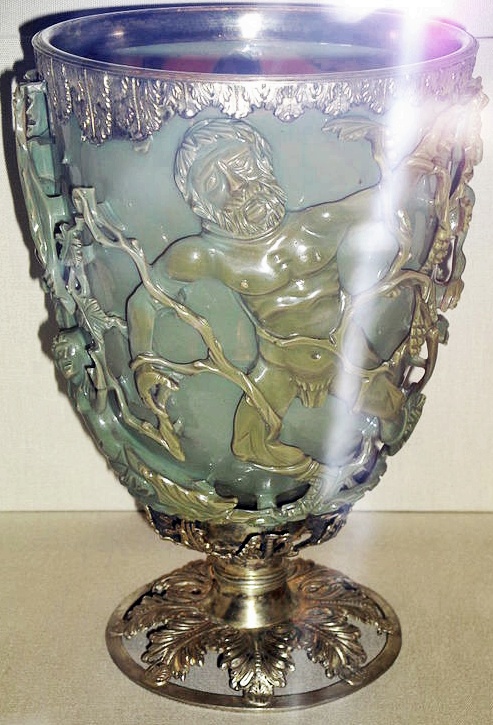
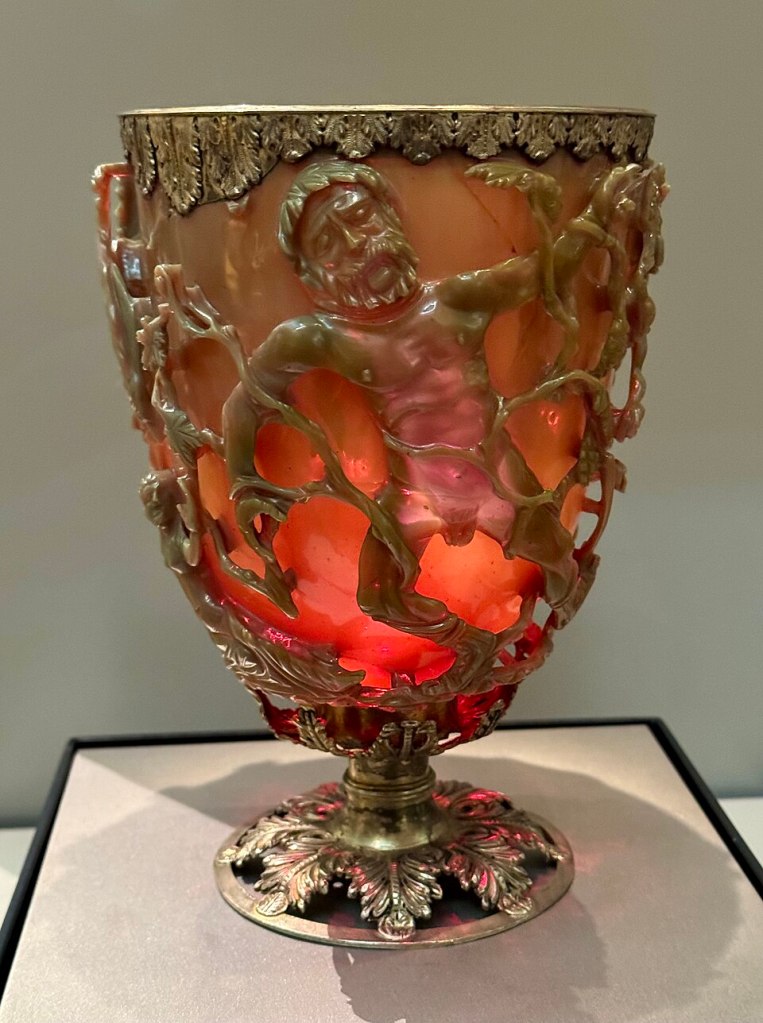
Faraday was not the first to make red gold. He was the first to ask properly what it was. The Lycurgus Cup, a Roman glass cup from the 4th century AD, looks green in reflected light and glows red when lit from inside. In 1990, researchers found tiny particles of silver and gold in its glass.
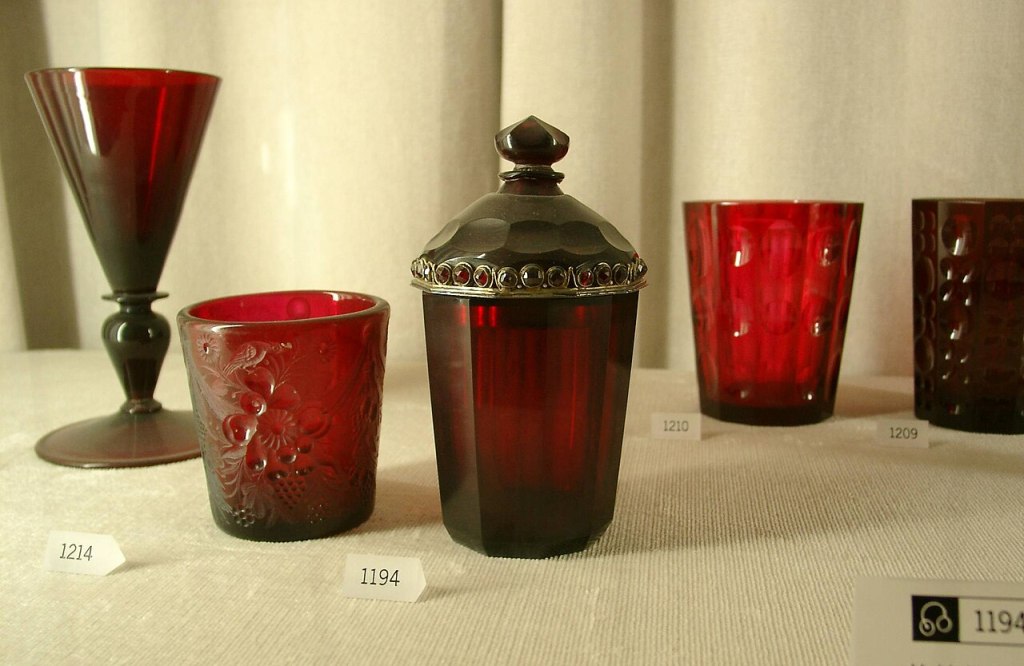
In the 17th century, glassmakers used a preparation called Purple of Cassius, made from gold salts and tin chloride, to make ruby glass. It is named after Andreas Cassius, who described it in 1676, although it was known earlier. Johann Kunckel made gold ruby glass in the 1670s and kept his recipe secret. These craftsmen knew the method. Nobody knew the reason.
The scientists who followed
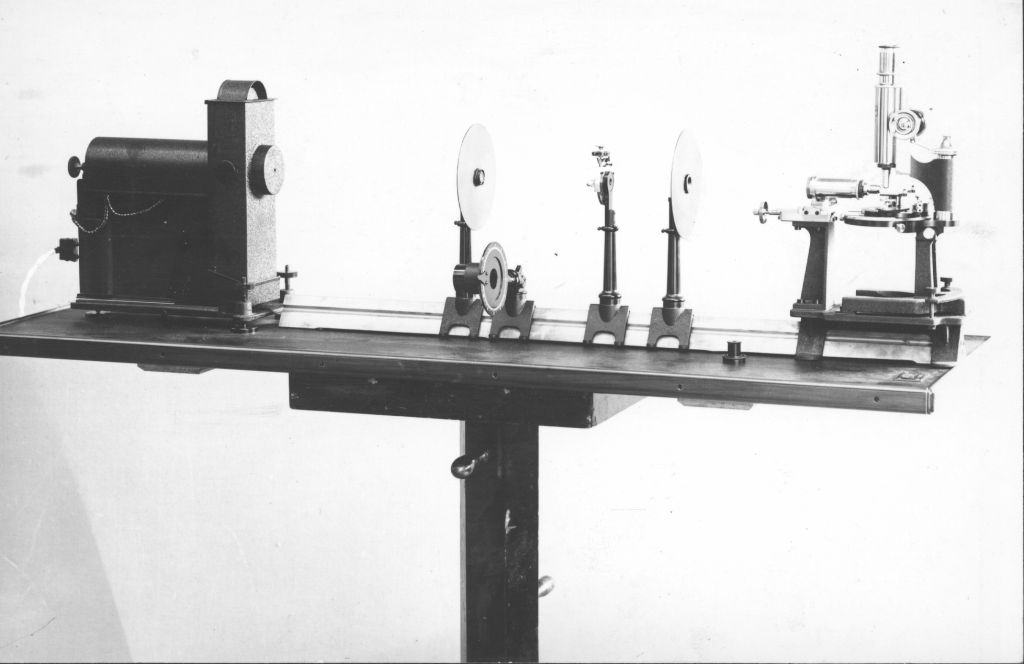
In 1903 Richard Zsigmondy and Henry Siedentopf built the ultramicroscope. It could not resolve the gold particles, but it could show the light each one scattered as a tiny point, so they could finally be counted. Zsigmondy won the 1925 Nobel Prize in Chemistry for his colloid work.
In 1908 Gustav Mie solved Maxwell’s equations for light hitting a small metal sphere. His theory explained how the color of gold colloids depends on particle size, and it is still used today. Colloid science grew into its own field, and in 1951 John Turkevich published a simple citrate method for making gold nanoparticles that labs still use.
A 150-year-old experiment still alive
Some of Faraday’s original ruby liquids are still at the Royal Institution, in the Faraday Museum. Shine a laser through them and the beam still lights up, more than 150 years later. Nobody knows exactly why the particles have stayed stable for so long, and the bottles cannot be opened to find out without disturbing them.
From a ruby liquid to nanotechnology
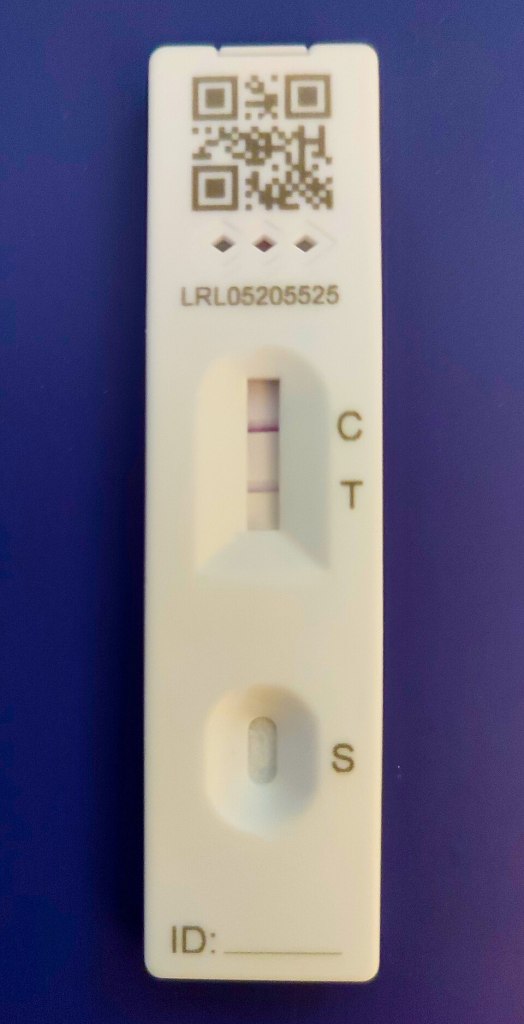
The red line on a home pregnancy test or a rapid COVID test is usually made of gold nanoparticles, the same red Faraday saw. Gold nanoparticles are also used in sensors and studied for catalysis and cancer therapy.
Go smaller still, to clusters of a few dozen atoms, and gold stops behaving like a metal. The plasmon disappears, and the particles absorb light more like molecules do. That is the world I work in, and it starts with Faraday’s bottle. More on these clusters in upcoming posts.
A legacy written in gold
Faraday did not set out to invent nanoscience. He noticed a tint in some rinse water and refused to ignore it. Careful observation, honest curiosity and a willingness to follow an accident: that is still how a lot of good science happens.
That’s this week’s lore. See you next time, a few nanometers further in.😉
Further reading
- M. Faraday, “The Bakerian Lecture: Experimental relations of gold (and other metals) to light”, Phil. Trans. R. Soc. Lond. 147, 145–181 (1857). doi:10.1098/rstl.1857.0011
- R. D. Tweney, “Discovering discovery: How Faraday found the first metallic colloid”, Perspectives on Science 14, 97–121 (2006). Project MUSE
- P. P. Edwards and J. M. Thomas, “Gold in a metallic divided state: From Faraday to present-day nanoscience”, Angew. Chem. Int. Ed. 46, 5480–5486 (2007). doi:10.1002/anie.200700428
- D. Thompson, “Michael Faraday’s recognition of ruby gold: the birth of modern nanotechnology”, Gold Bulletin 40, 267–269 (2007). doi:10.1007/BF03215598
- I. Freestone, N. Meeks, M. Sax and C. Higgitt, “The Lycurgus Cup: A Roman nanotechnology”, Gold Bulletin 40, 270–277 (2007). doi:10.1007/BF03215599
- L. B. Hunt, “The true story of Purple of Cassius”, Gold Bulletin 9, 134–139 (1976). doi:10.1007/BF03215423
- G. Mie, “Beiträge zur Optik trüber Medien, speziell kolloidaler Metallösungen”, Annalen der Physik 330, 377–445 (1908). doi:10.1002/andp.19083300302
- J. Turkevich, P. C. Stevenson and J. Hillier, “A study of the nucleation and growth processes in the synthesis of colloidal gold”, Discuss. Faraday Soc. 11, 55–75 (1951). doi:10.1039/DF9511100055
- R. Jin, C. Zeng, M. Zhou and Y. Chen, “Atomically precise colloidal metal nanoclusters and nanoparticles: Fundamentals and opportunities”, Chem. Rev. 116, 10346–10413 (2016). doi:10.1021/acs.chemrev.5b00703


Leave a Reply