


Your fingernails grow about one nanometer every second. Sit with that for a moment: while you read this sentence, each nail has grown by a few nanometers. You will never see it, never feel it, and yet it is happening.
A nanometer is one billionth of a meter: 0.000000001 m. That number is correct and almost useless, because our brains are not built to picture billionths. So let’s not try. Let’s compare it with things we already know.
Walking down the size ladder
Start with a single hair from your head. It is roughly 80,000 nanometers wide. You can see it, just about, if you hold it against the light.
- A red blood cell is about 7,000 nanometers across. Ten of them side by side would barely cross the width of that hair.
- A typical bacterium is around 1,000 to 2,000 nanometers long.
- A flu virus is about 100 nanometers wide. Here we have already left the world of ordinary light microscopes behind.
- The DNA double helix is about 2 nanometers wide.
- A single gold atom is roughly a third of a nanometer across. Line up three of them and you have one nanometer.
That last line is the one I find most striking. A nanometer is not some abstract unit far beyond the atom. It is the size of a handful of atoms. At this scale, you can count.
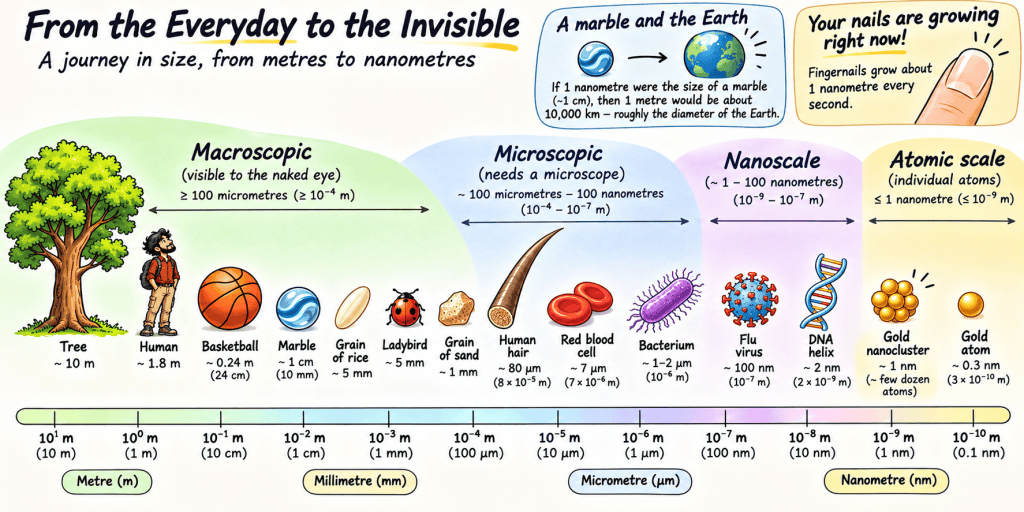
A marble and the Earth
Here is the comparison that finally made it click for me. If a nanometer were blown up to the size of a marble, about a centimeter, then a meter on the same scale would stretch around ten thousand kilometers. That is close to the diameter of the Earth.
So a nanometer is to a meter roughly what a marble is to our planet.
Why small is different
In December 1959, the physicist Richard Feynman gave a talk titled “There’s Plenty of Room at the Bottom”. He asked why we could not write the entire Encyclopaedia Britannica on the head of a pin, and pointed out that no law of physics forbids arranging matter atom by atom. He never used the word “nanotechnology”; that came later. But he had seen that there was a whole world down here, and that almost nobody was looking at it.
Feynman saw the room. What he could not have fully known is how strange it would be inside.
If shrinking things only made them smaller, nobody would care about nanometers. The reason chemists and physicists do care is that materials start to behave differently when they get this small.
Take gold. A gold ring is yellow and shiny. Grind gold down to particles a few tens of nanometers across, suspend them in water, and the liquid turns ruby red. Michael Faraday made exactly such a red gold liquid in the 1850s, and medieval glassmakers used the same effect to colour stained-glass windows long before anyone knew why.
Go smaller still, down to clusters of just a few dozen gold atoms about a nanometer across, and gold stops behaving like a metal at all. These tiny clusters have exact chemical formulas, like molecules. Some of them glow when you shine light on them. One extra atom can change their colour.
Part of the reason is surface. In a gold ring, almost every atom is buried deep inside, surrounded by other gold atoms. In a one-nanometer cluster, most atoms sit at or near the surface, exposed to the outside world. The material is almost all edge. Electrons, too, are squeezed into such a small space that their behaviour changes, and with it the way the material absorbs and gives off light.
The scale where I work
Much of my own research happens right here, at around one nanometer: making clusters of silver and gold atoms, solving their structures atom by atom, and watching how they respond to light in the first trillionths of a second. It is a strange and beautiful place, too small to see but just large enough to count.
That is what Moleculore is about: the stories hiding at this scale, and what they tell us about the world we can see.
That’s this week’s lore. See you next time, a few nanometers further in.😉


Leave a Reply