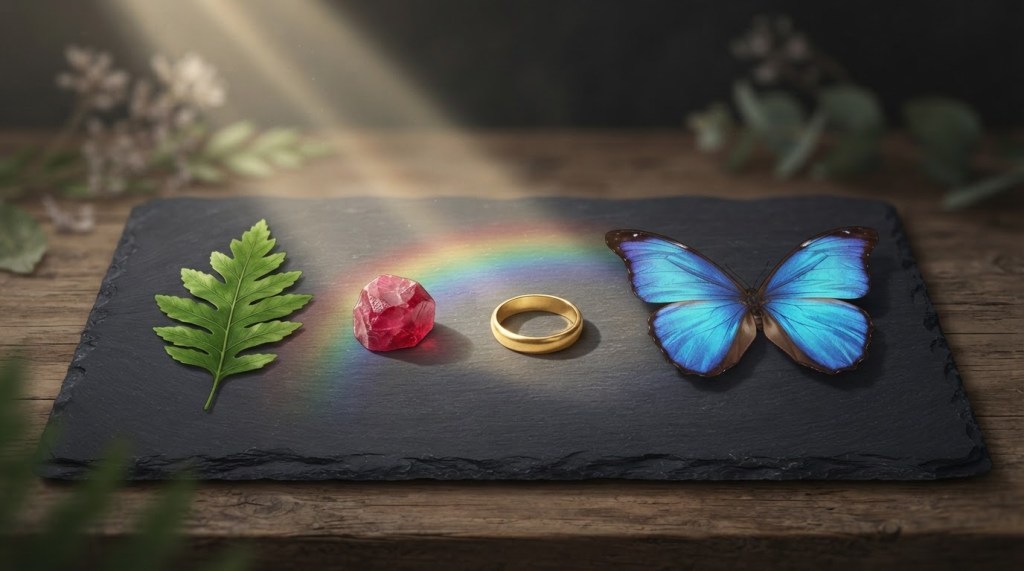

Here is a puzzle. A green leaf, a red ruby, a yellow gold ring, the blue sky. They all have colour, but they get it in completely different ways.
White light from the Sun is a mix of all the colours of the rainbow. When that light meets something, the thing either takes some colours away or sends some colours off in a new direction. The colour you see is whatever light is left over and reaches your eye. Every coloured thing in the world is playing some version of that game. The rules just change depending on what the thing is made of and how it is built.
Leaves are green because they eat the other colours
Inside every leaf is a molecule called chlorophyll. Chlorophyll’s job is to catch sunlight so the plant can make food. Chlorophyll is very good at soaking up red light and blue light. It is not good at using green light. So the green light bounces back out of the leaf, and that is what reaches your eye. So when you call a leaf green, you are really naming the colour the leaf did not want.
Most dyes and paints work the same way. A red shirt is red because the dye in it absorbs, or soaks up, most of the other colours and lets the red through.
Rubies and emeralds owe their colour to one tiny impurity
A ruby is mostly aluminium oxide, a crystal that is clear and colourless when it is pure. Add a small amount of chromium, around 1 percent or less, and the crystal turns deep red.
Now the strange part. An emerald gets its green from chromium too. Same metal, totally different colour. The reason is the neighbourhood. Each chromium atom sits in a crystal, surrounded by other atoms. Those neighbours push on the chromium’s electrons. Electrons are the tiny charged particles that move around atoms. How hard the neighbours push decides which colours of light the electrons can soak up. In a ruby, the push is a bit stronger. In an emerald, it is a bit weaker. That small difference is enough to turn red into green.
Gold is yellow for a reason that surprised scientists
Most metals, like silver, aluminium and steel, look silvery-white. They bounce back almost all colours of light equally. Gold is different. It soaks up some of the blue light and bounces back the rest, which looks yellow.
Why is gold the odd one out? Gold atoms are very heavy. In heavy atoms, some electrons move so fast that Einstein’s ideas about speed and energy (relativity) start to matter. This shifts gold’s energy levels just enough that it can absorb blue light. In silver, the same absorption happens too, but in ultraviolet light, which our eyes cannot see. So silver looks silver. Without relativity, gold would look much like silver.
Here is a bonus. Cut gold into pieces a few billionths of a meter across and it stops looking yellow. It can look red or purple instead. Glassmakers used this for centuries to make red stained glass, long before anyone knew why it worked.
The sky is blue because air throws blue light around
The sky has no dye and no blue pigment. Air is mostly nitrogen and oxygen, and both are colourless. When sunlight passes through the air, the tiny gas molecules scatter some of it, sending it off in all directions. Small particles scatter short-wavelength light, the blue end of the rainbow, much more strongly than long-wavelength light, the red end. This is called Rayleigh scattering, after the British scientist Lord Rayleigh. So blue light gets bounced all around the sky. Wherever you look, some of that scattered blue is coming toward you.
Why not violet, which scatters even more? The Sun gives out less violet than blue, and our eyes are less sensitive to it. Together, we see blue. At sunset, sunlight travels through much more air to reach you. Most of the blue gets scattered away along the path, and the reds and oranges are what’s left.
Butterfly wings make colour with shape, not pigment
The bright blue Morpho butterfly has almost no blue pigment in its wings. Its wings are covered in tiny scales. Each scale has ridges and layers far too small to see, about the same size as a wavelength of light. When light bounces off these layers, the reflected waves add together for blue light and cancel each other out for other colours. This is called interference.
You can tell this kind of colour apart because it often shifts as you tilt your head. That shimmer is called iridescence. Soap bubbles, peacock feathers and the back of a CD all do it.
There is a neat test. If you put a drop of a clear liquid like alcohol on a Morpho wing, the liquid fills the tiny gaps and the colour changes or fades. When it dries, the blue comes back. The colour was never a substance. It was a shape. Colour is not something objects have, it is something they do to light: soak it up, scatter it or bend it with their shape.
I hope you enjoyed seeing ordinary colours a little differently. Next time you look at a leaf, a gold ring or a sunset, you’ll know which game the light is playing.
That’s this week’s lore. See you next time, a few nanometres further in.😉


Leave a Reply