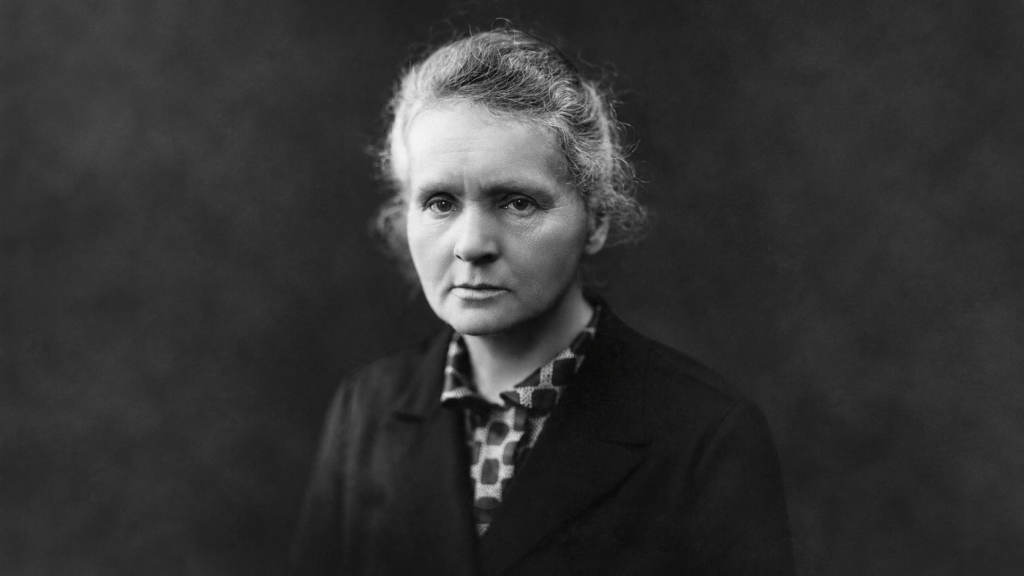

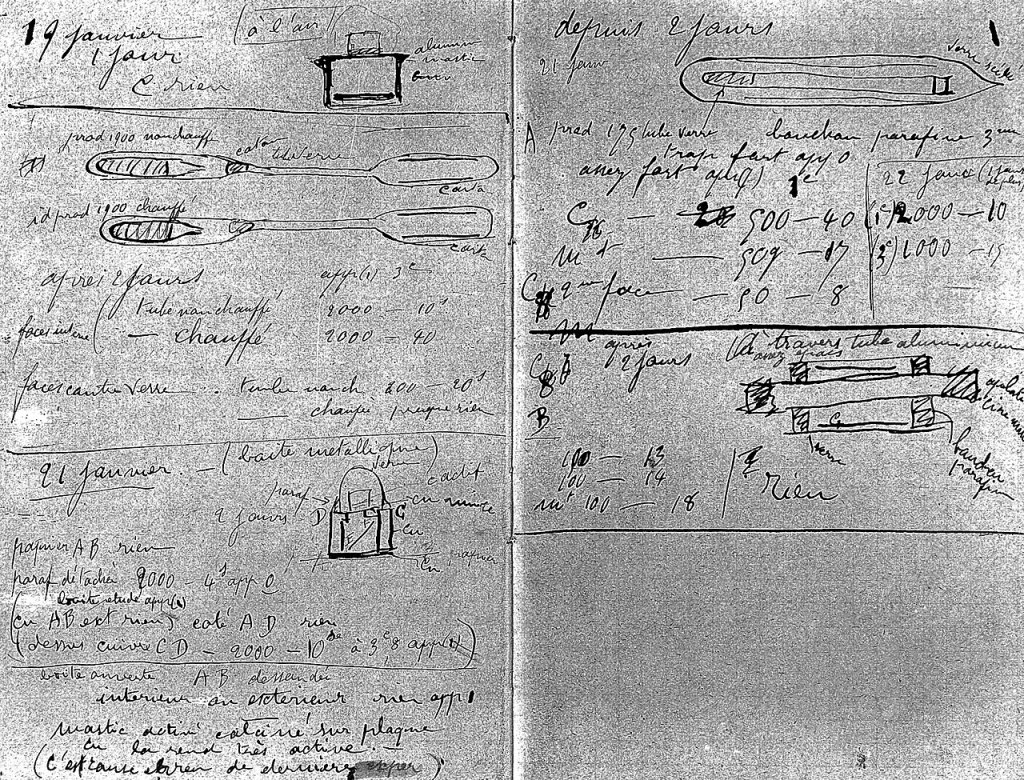
In Paris, in the national library, there are a few notebooks that you can’t just walk up and read. They are kept in lead-lined boxes. If you want to open one, you sign a form saying you understand the risk, and you put on protective gear.
The notebooks belonged to Marie Curie. The pages are still contaminated with radium, which has a half-life of about 1,600 years. Since she wrote in them, the radioactivity has barely dropped. They will be dangerous long after all of us are gone.
The notebooks are fascinating in their own right. But the woman behind them deserves a closer look. So this post is about her.
A girl who wasn’t allowed to study
She was born Maria Skłodowska in Warsaw in 1867. Poland was then ruled by the Russian Empire, and the University of Warsaw did not admit women. Her parents were both teachers, so learning was everywhere at home. Doors outside the home were mostly shut.
So she studied at the “Flying University”, a secret school that kept moving from house to house so the authorities wouldn’t find it. Then she and her older sister Bronisława made a deal. Maria would work as a governess and send money to Paris so Bronisława could study medicine. Once Bronisława was a doctor, she would pay for Maria.
It took years. Maria finally reached Paris in 1891. She was 24.
Paris on bread and tea
She enrolled at the Sorbonne as Marie and lived in a tiny attic room. In winter it was so cold that, according to her daughter Ève, she slept with all her clothes piled on top of her. She often forgot to eat. She also came first in her physics degree in 1893 and second in mathematics a year later.
In 1894 she met Pierre Curie, a quiet physicist who had already done important work on crystals and magnetism. They married in 1895. Their honeymoon was a bicycle trip around the French countryside, which tells you a lot about both of them.
A thesis topic nobody wanted
In 1896 Henri Becquerel had found that uranium gives off invisible rays. Almost nobody followed it up. X-rays, discovered a year earlier, were far more exciting. Marie picked Becquerel’s rays for her doctorate anyway.
Using a very sensitive electrometer built by Pierre and his brother, she measured how strongly different materials ionized the air around them. Her measurements revealed two important observations. The effect depended only on how much uranium was there, which meant it came from inside the atoms themselves. And one uranium ore, pitchblende, was far more active than its uranium content could justify. Something else was hiding in it.
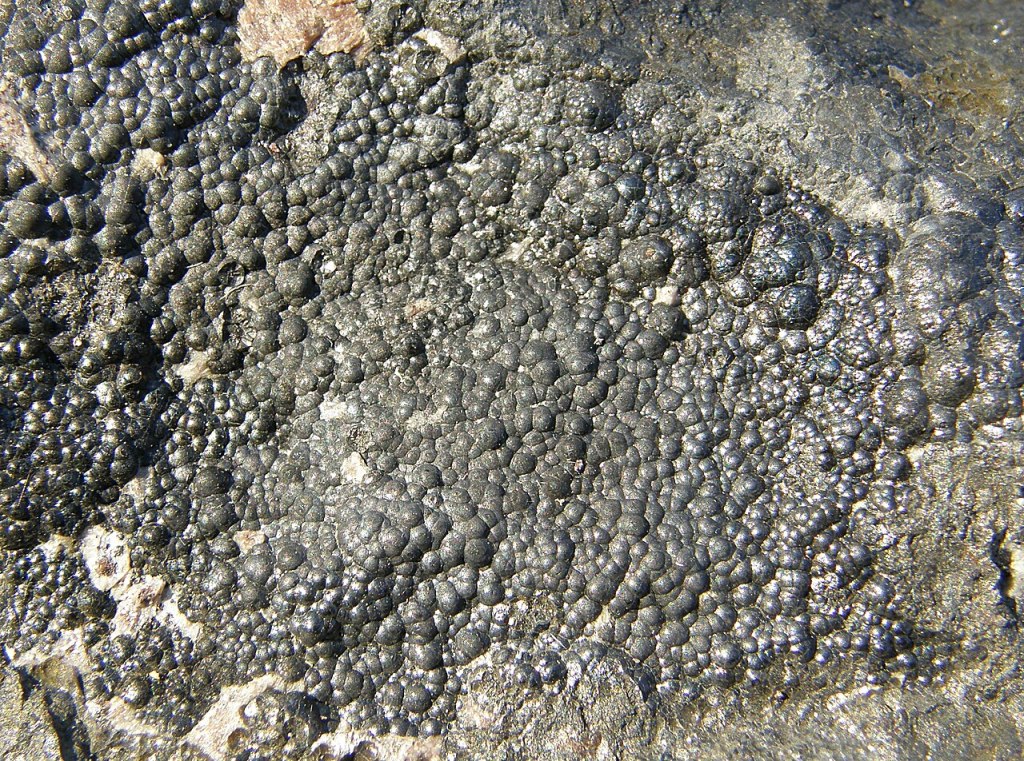
She gave the phenomenon a name: radioactivity. Pierre dropped his own research to join her. In July 1898 they announced a new element and called it polonium, after the country she had left. In December came a second one. They called it radium.
Four years in a shed
Discovering radium was only the beginning. The next challenge was to isolate enough of it to convince other chemists that it was a new element. Chemists wanted to see radium and weigh it. There was only a tiny trace in each ton of ore.
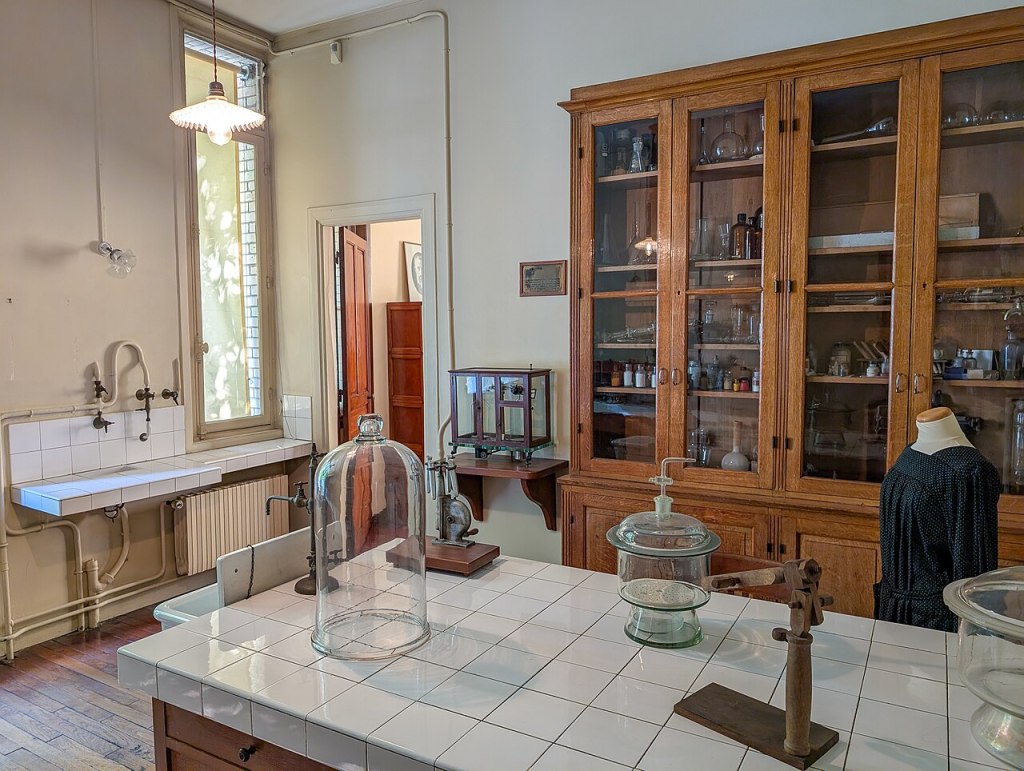
Their lab was an old shed across the courtyard of Pierre’s school. It had once been a dissecting room for medical students. The roof leaked, it was freezing in winter, and the fumes had nowhere to go. Marie stood over cauldrons of boiling ore, stirring with an iron rod nearly as tall as she was, then purified the results again and again.
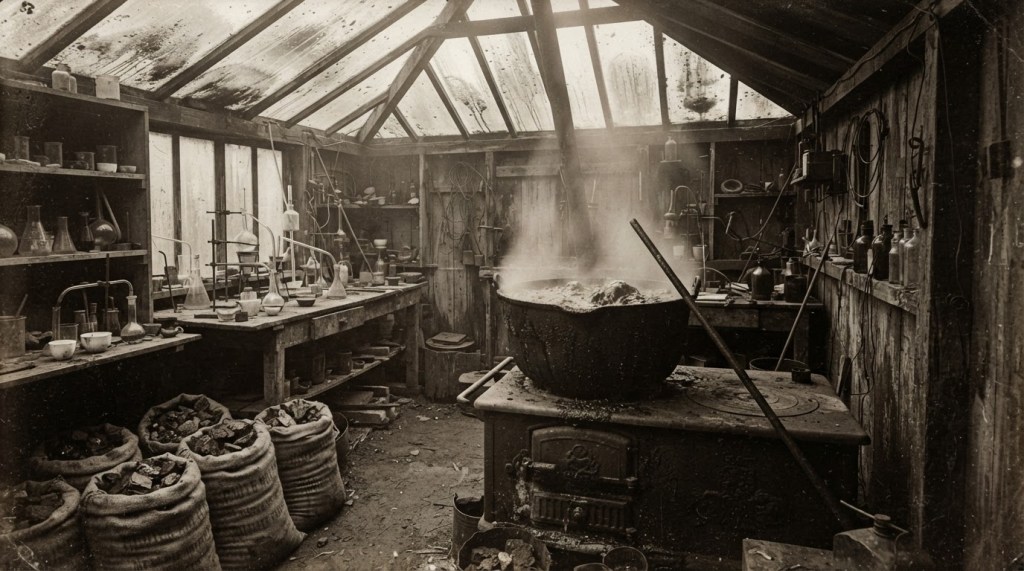
By 1902, after processing several tons of pitchblende residue, she had about a tenth of a gram of radium chloride. Less than a grain of rice. Enough to measure radium’s atomic weight, and enough to prove she was right.
Some evenings they walked back to the shed just to look at their samples. The tubes glowed softly in the dark. In her own notes she compared them to faint fairy lights. She kept radium in her desk drawer and carried tubes in her pocket. The long-term consequences of handling these materials were still unknown.
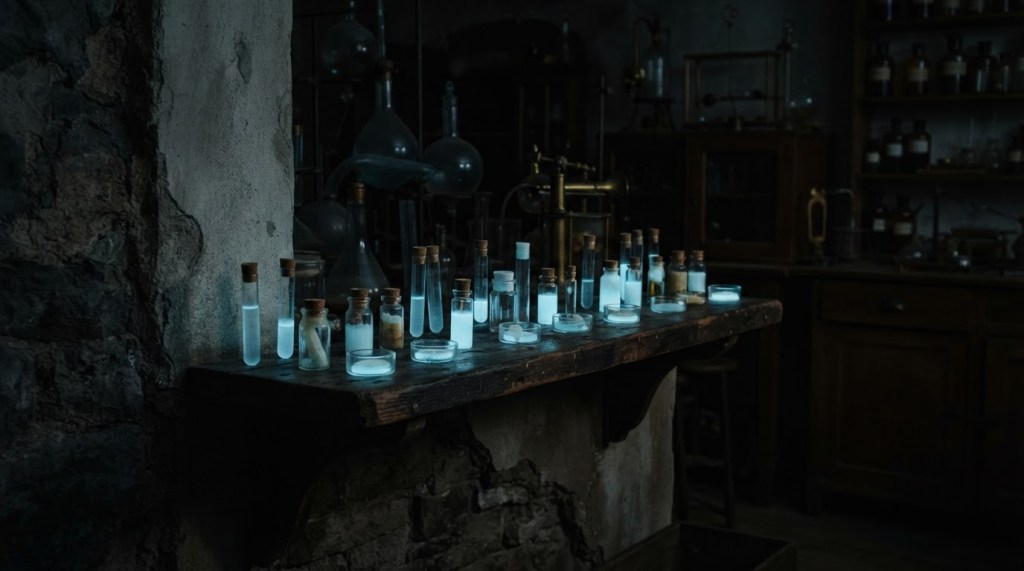
Those were the notebook years. The pages she filled between 1899 and 1902 are the ones in the lead boxes now.
Almost left off her own prize
In 1903 the French Academy of Sciences nominated Becquerel and Pierre for the Nobel Prize in Physics. Not Marie. A Swedish mathematician, Gösta Mittag-Leffler, quietly warned Pierre. Pierre wrote back that if he was being considered, he wanted to be considered together with her.
That December, Marie became the first woman to win a Nobel Prize. She almost didn’t, for reasons that had nothing to do with the science.
Losing Pierre
In April 1906, on a rainy Paris street, Pierre slipped and fell under a horse-drawn wagon. He died instantly. Marie was 38, with two daughters, Irène and Ève.
The Sorbonne offered her Pierre’s position. She became the university’s first woman professor. At her first lecture, the hall was packed with people expecting a speech about her husband. She simply started from the sentence where his last lecture had ended.
The worst year
1911 should have been a good year. Instead, in January, the French Academy of Sciences voted on whether to admit her. She lost by two votes. Later that year the newspapers found out about her relationship with the physicist Paul Langevin, who was unhappily married. Letters were stolen and printed. Crowds gathered outside her house. Parts of the press called her a foreigner who had wrecked a French family.
In the middle of all this, the Nobel committee awarded her a second prize, this time in chemistry, for discovering radium and polonium. One member, Svante Arrhenius, then wrote suggesting she stay away from the ceremony. She replied that the prize was for her work, and her private life had nothing to do with it. She went to Stockholm. She is still the only person to win Nobel Prizes in two different sciences.
X-rays on wheels
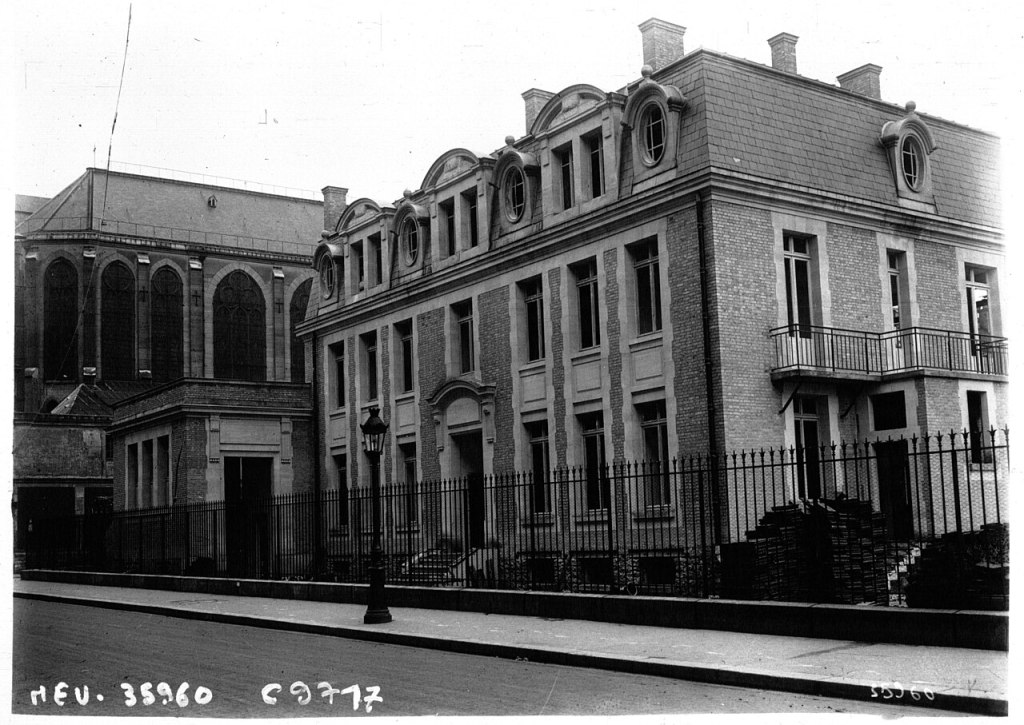
Her new Radium Institute was finished in the summer of 1914, just as the First World War began. Most of her staff left to fight.
X-ray machines could show surgeons exactly where a bullet was, but they sat in city hospitals far from the front. So Curie put them in cars. She asked wealthy friends to donate vehicles, fitted about 20 of them with X-ray equipment and a generator, learned to drive, and took them to the front herself, often with Irène, then a teenager. The soldiers called them “petites Curies”, little Curies.
She also set up about 200 fixed X-ray rooms and trained around 150 women to run them. By the end of the war, more than a million wounded soldiers had been X-rayed.
The price
For decades she worked with radium bare-handed. Her fingers were cracked and scarred, and her eyesight failed. She never fully accepted that radium was the cause. She died on 4 July 1934 of aplastic anemia, a failure of the bone marrow now linked to her long exposure to radiation.
A year later, her daughter Irène and Irène’s husband Frédéric Joliot won the Nobel Prize in Chemistry for making artificial radioactivity. Marie didn’t live to see it.
What stays with me
As a chemist, I find myself returning to that shed. Not to the discovery itself, but to the chemistry that followed it. Imagine working with several tonnes of an unremarkable black mineral, separating its constituents through endless cycles of dissolution, precipitation and crystallisation, all to isolate a substance present in vanishingly small quantities. The reward, after years of work, was barely a tenth of a gram of radium chloride.
There is something extraordinary about that kind of experimental persistence. Today, we have instruments that can reveal the presence of trace elements with remarkable sensitivity. The Curies had to develop an entire chemical separation strategy around the activity they measured. They couldn’t simply look for radium. They had to follow it through every separation.
That is the part of her work I find most remarkable.
She encountered resistance at almost every stage of her career. Women were excluded from universities in her homeland, her contribution to the first Nobel Prize was initially overlooked, and the French Academy refused her membership. Yet she continued working, often with little interest in the attention surrounding her. The notebooks are still radioactive. In a way, so is she.
That’s this week’s lore. See you next time, a few nanometers further in.😉
Further reading
- P. Curie and M. Curie, “Sur une substance nouvelle radio-active, contenue dans la pechblende,” Comptes rendus de l’Académie des Sciences 127, 175 (1898).
- P. Curie, M. Curie and G. Bémont, “Sur une nouvelle substance fortement radio-active, contenue dans la pechblende,” Comptes rendus de l’Académie des Sciences 127, 1215 (1898).
- M. Curie, “Radium and the new concepts in chemistry,” Nobel Lecture, 11 December 1911. nobelprize.org
- M. Curie, Pierre Curie, with Autobiographical Notes by Marie Curie (Macmillan, New York, 1923).
- È. Curie, Madame Curie: A Biography (Doubleday, 1937).
- S. Quinn, Marie Curie: A Life (Simon & Schuster, 1995).
- American Institute of Physics, “Marie Curie and the Science of Radioactivity” (online exhibit). history.aip.org
- T. J. Jorgensen, “How Marie Curie brought X-ray machines to the battlefield,” Smithsonian Magazine (2017). smithsonianmag.com
- H. Markel, “The day Marie Curie got snubbed by the French science world,” PBS NewsHour (2021). pbs.org


Leave a Reply